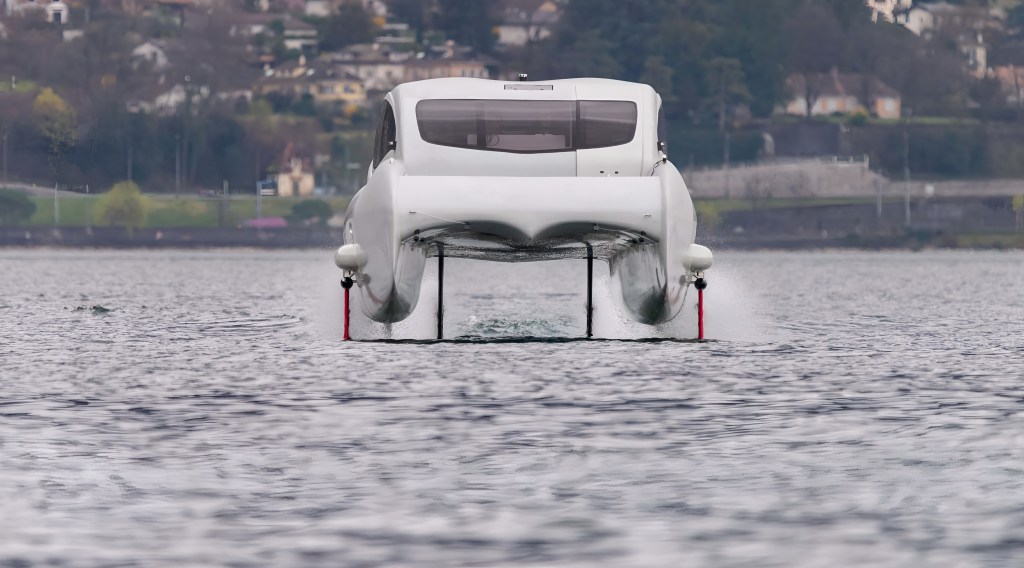
MobyFly, a startup incubated at UPTEC – Science and Technology Park of the University of Porto, has raised €10.8 million in a Series A funding round to accelerate the commercialization of its electric boats.
The round was led by Fonds Révolution Environnementale et Solidaire, financed by the social dividend of Crédit Mutuel Alliance Fédérale, and managed by Crédit Mutuel Impact, UPTEC announced in a statement. Private investors and institutional partners also participated
Founded in 2020 in Switzerland by Sue Putallaz, Anders Bringdal, and Portuguese entrepreneur Ricardo Bencatel, MobyFly is developing high-performance electric boats equipped with hydrofoil technology.
Hydrofoils are wing-shaped structures capable of lifting a boat out of the water, enabling it to carry hundreds of passengers at speeds exceeding 70 km/h.

According to the company, these boats consume up to 80% less energy than diesel vessels and reduce operating costs by around 60%, while also eliminating waves, noise, and polluting emissions.
For Bencatel, chief technology officer at MobyFly, the funding marks a decisive milestone. “This investment will enable MobyFly to scale up its operations, expand its engineering and R&D capabilities, accelerate the commercialization of its zero-emission hydrofoil technology, and reinforce its commitment to sustainable and profitable maritime transport,” he stated.
The startup plans to use the funds to industrialize and certify its technology, continue developing hydrofoil systems, and support entry into new international markets. MobyFly has also set clear objectives for the coming years.
By 2025, the company intends to launch pre-series production of the MBFY-S model, a vessel designed to carry up to 20 passengers. In 2026, it aims to launch its first production model during the summer and sell several units for passenger transport by the end of that year.
The funding comes at a time when the electric boats sector is gaining momentum. Market research indicates that the global electric boats market will grow from $7.25 billion in 2024 to $8.22 billion in 2025.
This growth is driven in part by environmental pressures. Maritime transport currently accounts for around 3% of global greenhouse gas emissions, making the shift toward zero-emission solutions a pressing priority.
According to reporting under the Sea Cargo Charter – a framework developed by the Global Maritime Forum to align shipping emissions with climate targets – many shipowners and charterers are reducing their emission intensity.
Still, most remain below minimum alignment goals, underscoring both the urgency of decarbonization and the potential role of zero-emission technologies such as hydrofoil electric vessels.
Featured image: MobyFly’s mission is to make maritime transport sustainable with zero-emission hydrofoil boats that consume less energy and cut operating costs. (Photo courtesy of MobyFly)


 Portugal Startup News