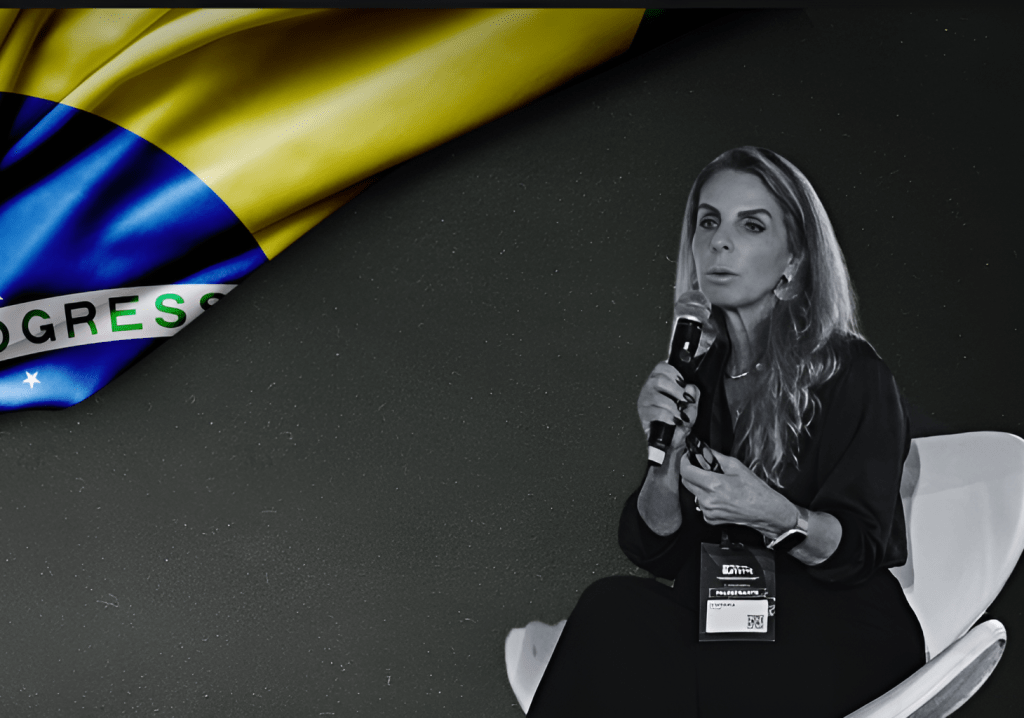
By Cristinna Araujo – Lawyer, investor, and CEO of MyEuroBusiness
When we think about internationalization, many Portuguese startups look first to Europe. It makes sense: geographic proximity, familiar regulation, and easier access to capital. But what if your next big opportunity was not across the border, but across the Atlantic?
Brazil is a market of more than 200 million consumers, but more than that: it is a living laboratory where startups learn to grow in contexts of diversity, complexity, and resilience that simply do not exist in Europe. For a Portuguese startup, expanding here is not just about opening a new market: it is about gaining the strength to compete globally.
The country where Portuguese startups can learn from the improbable
Brazil does not have the easiest market. It does not have the lightest bureaucracy. It does not have the simplest access to capital. And that is exactly why it is fascinating.
I remember a conversation with a friend who took his company abroad. He told me: “Doing business abroad was like going up an escalator in the right direction: everything pushed me upward, government, financial institutions, support networks, tax environment. In Brazil, it was the opposite. I tried to go up, but the escalator was working against me, pushing me down the whole time.”
It is in this scenario of resistance that Brazilian startups are born. Not in stable or predictable environments, but in the middle of the storm. And that is why they are resilient from day one.
For Portuguese startups, this is the key point of learning. The Brazilian innovation map spreads from the intense streets of São Paulo to the technological strength of Florianópolis and the creative communities of Recife. In Rio de Janeiro, hubs like Arca Hub are bringing together technology, the creative economy, and international partnerships, including with Portugal – such as the collaboration with Unicorn Factory Lisboa.
While in many countries innovation happens in “controlled” environments, in Brazil it happens on the battlefield. And it is on this battlefield that strong, scalable business models are forged, ready to cross borders.
For Portuguese startups, looking at this adverse yet incredibly fertile environment is to see a living laboratory of resilience and creativity that can accelerate their own global expansion.
The maturity of those who cannot afford to fail
More than half of Brazilian startups are already in the traction or scale stage, according to the ABStartups 2024 Startup Mapping.
We are not talking about ideas on napkins. We are talking about companies with an average annual revenue of R$ 737,000 (about €117,773) and teams of around 20 employees, working in major production chains.
These startups do not have the luxury of failing indefinitely. Every step needs to be validated quickly because the environment demands it. This creates a pragmatic culture, which combines vision of the future with discipline of execution.
For Portuguese startups, this is a strategic point: understanding that Brazil teaches how to grow in adversity. This is the country’s invisible asset, businesses that learn to thrive in uncertain scenarios and arrive more prepared to consolidate in more stable global markets.
Sectors that directly matter to Portuguese startups
To understand the future, you only need to look at what is happening in Brazil right now. The country has become fertile ground for sectors at the center of the European agenda:
Fintechs: they have already banked millions in record time, making Brazil one of the most innovative ecosystems in the sector.
Healthtechs: they learned to operate in complex and unequal systems, creating solutions that can be replicated anywhere in the world.
Agtechs: they develop technologies that not only feed Brazil but integrate global production chains, directly impacting global food security.
Climate techs: they are already reforesting the Amazon with the support of giants such as Google.org and Microsoft Sustainability.
For Portuguese startups, this is not just inspiration – it is an opportunity for strategic connection. What is happening today in Brazil mirrors the green and digital agenda of the European Union. In practice, it means that validating solutions in Brazil is also validating solutions for the markets where Portugal wants to lead in Europe.
Brazil as a testing ground and springboard for Portuguese startups
What many Portuguese startups have not yet heard is that Brazil may be the best place in the world to validate an MVP. The diversity of consumers, regulatory complexity, and logistical challenges transform the country into a real-scale laboratory. If a product works in Brazil, it is far more likely to work in any other global market.
A concrete example comes from sheerMe, a Portuguese startup that, in its second year of operation, chose Brazil as its first international expansion. The decision proved right: entering the Brazilian ecosystem not only accelerated its market validation but also boosted its global visibility, opening doors to new opportunities on other continents.
And Brazil continues to attract the European eye. At this very moment, we are also supporting a Swedish startup that has not yet commercialized in its own country but chose Brazil to validate its MVP. The result is always surprising: engaged customers, fast insights, and learnings that accelerate international expansion.
The message is clear for Portuguese entrepreneurs: Brazil, when well explored, is not just a market. It is a catalyst for internationalization. It should not be seen as a limit, but as a springboard.
Portuguese startups that validate in Brazil come out much stronger to conquer markets in Europe, the United States, or Asia.
Soft landings almost no one talks about
There are discreet spaces that function as secret entry points into the Brazilian ecosystem. Little publicized but extremely strategic, they are valuable shortcuts for Portuguese startups wishing to enter Brazil:
Arca Hub (Rio de Janeiro): located in the South Zone, it connects foreign startups to clients and investors. Its partnership with Unicorn Factory Lisboa creates a true transatlantic corridor, allowing Portuguese startups to find immediate support in Brazil without losing their connection to Europe.
Bossa Nova Investimentos: one of the main seed funds in Latin America, but also a hub of acceleration and co-investment that opens doors where reports and official guides do not reach.
Sai do Papel (Rio de Janeiro): more than a hub, it is a complete platform for innovation and investments, with a venture capital arm, acceleration, and corporate connections. It has already supported giants such as BNDES, IBM, and XP, as well as early-stage startups. For those arriving from abroad, it is one of the smartest ways to enter the Carioca ecosystem without wasting time with the local learning curve.
These hubs do not appear in the “official catalogs”. And that is precisely why they are valuable. They are like those hidden Portuguese taverns where you taste the true essence of local cuisine, far beyond tourist restaurants. Whoever discovers these spaces finds invisible opportunities – the ones almost no one is exploring, but that make all the difference for those who know how to recognize the authentic flavor of an ecosystem.
Where Portuguese startups can test at real scale
For Portuguese startups that have already validated their value proposition in smaller markets, Brazil emerges as a living laboratory capable of accelerating learning at scale. It is not just a market: it is a continent disguised as a country, where each region represents a new journey of clients, regulations, and business models.
São Paulo is the epicenter of capital and large corporations. For a startup coming from Portugal, this is where global clients, investment funds, and immediate scale challenges are found. Validating here means understanding the logic of high-speed competition.
Rio de Janeiro is the underestimated market that proves strategic. Far beyond the touristic image, Rio connects technology, creative economy, and corporate innovation. For Portuguese startups, it can serve as a natural soft landing, with hubs like Arca Hub and Sai do Papel facilitating the first step and creating global connections.
Florianópolis is the island of innovation. With a strong presence in deep tech and software, the city brings together highly qualified talent and a fertile environment to test high-impact solutions, especially in technology applied to industry and digital services.
Few say this so clearly: testing in Brazil is more than validating a product, it is validating resilience. If it works in São Paulo, your startup has learned to deal with the logic of capital. If it works in Rio, you have understood how to navigate complex networks and build global connections. If it works in Florianópolis, you have proven your technological strength.
For Portuguese startups, this journey in Brazil is real-scale training. Those who survive here not only validate their business model but acquire the muscle necessary to compete and grow in any global ecosystem.
The lesson is clear for Portuguese startups
Brazil is about real scale. Europe is about global scale. Together, they form a strategic bridge capable of defining the future of any startup that wants to compete at a world-class level.
For Brazilian startups, Portugal and Europe represent the smartest gateway to internationalization: structured access, stable regulation, and an ecosystem increasingly connected to European capital.
For Portuguese startups, Brazil is the living laboratory on a continental scale, where products and business models are tested in conditions that do not exist in Europe. Validating in Brazil means gaining resilience, speed, and global vision.
Those who know how to explore this Brazil-Portugal complementarity will not just survive: they will be prepared to lead in the global arena.
About the author:
Cristinna Araújo is a Portuguese-Brazilian lawyer, investor, CEO of MyEuroBusiness, and ambassador for ALAS (Latin American Startup Alliance). She supports companies in expanding safely and strategically into Europe, with a focus on Portugal, specializing in securing public funding, legal structuring, and connecting to the European innovation ecosystem.
Featured image: Cristinna Araujo, CEO of MyEuroBusiness (Photo courtesy of Cristinna Araujo)
Disclaimer: The opinions expressed in contributed opinion pieces are those of the authors and do not necessarily reflect the views of Portugal Startup News.



 Portugal Startup News