By Frederico Stock – Co-founder and CFO at CleoCare
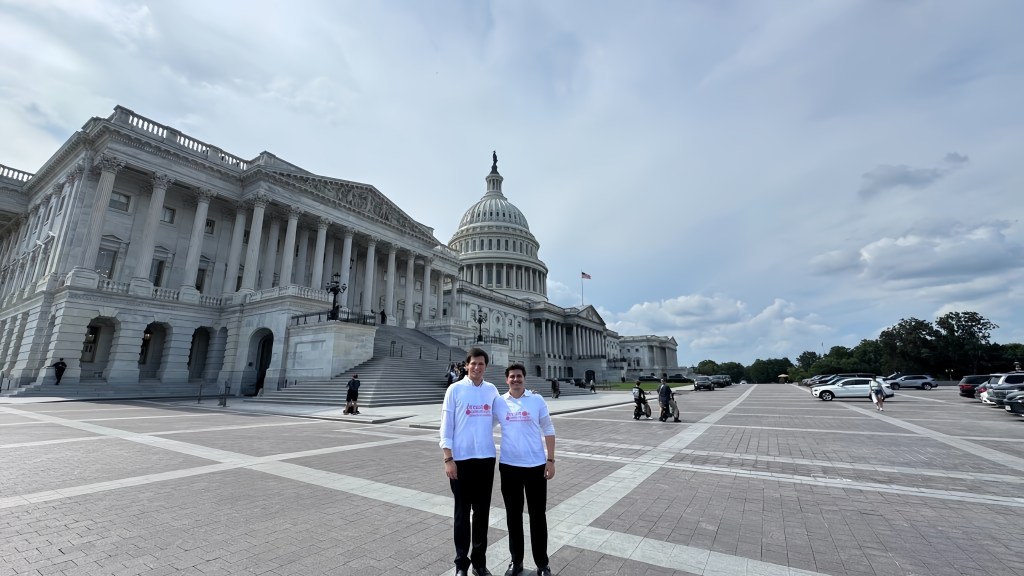
In July, CleoCare participated in Capitol Hill Days in Washington, D.C., as part of our membership in the Breast Cancer Early Detection Coalition (BCEDC). As a young Portuguese femtech startup participating in these policy conversations, we were offered something rare for companies at our stage: direct exposure to the complexities of health legislation, access, and systemic change.
And in many ways, that day marked the beginning of something larger: a continuous, long-term effort to ensure that women’s health innovation from Portugal has a voice in global policy conversations.
On December 1st and 2nd, we will again participate in Hill meetings, a strategy retreat for coalition members, and a luncheon with Senator Collins. Our participation is part of an ongoing effort within the coalition to influence policy that advances early detection and reduces inequities in breast cancer screening.
This continuity (showing up, learning, and contributing where we can) is where the real impact lies. And for Portugal’s growing femtech ecosystem, it represents an important case study in how startups can play a role in shaping the broader health environment they operate in.
Policy and innovation are inseparable
Walking through the halls of the Senate and the House of Representatives was a reminder that innovation and policy are deeply entangled. As founders, we often focus on the product: the technology, the user experience, the clinical validation. But on Capitol Hill, one message came through with clarity: Innovation is only impactful when the system around it allows it to reach people.
This is why bills such as the Find It Early Act, the Access to Breast Cancer Diagnostics Act, and the EARLY Act dominated our discussions. These policies aim to close gaps in supplemental screening, education, and access, gaps that exist not only in the United States, but across Europe.
Portugal has a different health model, but the underlying challenges are familiar. Early detection rates are strong overall, yet disparities persist between urban and rural populations, and breast density is still poorly understood among younger women.
This is the core insight we brought back home: femtech founders must engage in public policy if they want their solutions to matter at scale.
Technology alone is never enough. Real change happens at the intersection of tools, systems, and public awareness.

Showing up again matters more than showing up once
A misconception about policy work is that the impact lies in a single meeting or visit. In reality, progress is incremental. Policymaking is slow, iterative, and built on relationships, not visibility.
This is why our return to Capitol Hill on December 1st and 2nd is important.
Not because it signals prestige, but because it reflects consistency.
Our July participation allowed us to:
- learn how legislative offices evaluate early detection issues;
- understand which data points resonate;
- listen to the experiences of other coalition members;
- see how advocacy messages evolve in real time.
Returning now allows us to:
- contribute to ongoing conversations with better context;
- share what we’ve learned since July;
- help define priorities for the coalition’s 2026 strategy;
- reinforce the message that early detection requires continuous attention.
This approach, steady, long-term, and grounded in collaboration, is something Portugal’s femtech founders can learn from.
Visibility is valuable. Consistency is transformative.
What the Portuguese femtech ecosystem can take from this experience
Portugal can become a meaningful player in the global femtech landscape, but only if we internalize a few key lessons from these experiences:
1. Femtech is not a niche
Women’s health innovation is not a vertical. It is half of all humanity. Impacting half the population can drive significant long-term healthcare costs. Startups working in this space should be seen as essential contributors, not “specialized” players.
Femtech potential can only be unlocked only when investors, regulators, and founders view it through this lens.
2. Policy engagement should start early
Startups must be present in international working groups, associations, coalitions, and policy discussions. Waiting to be “big enough” misses the point. By the time a company is big, its impact could have been magnified by earlier involvement.
3. Evidence matters more than storytelling
In D.C., no narrative is strong enough to replace data. The same will increasingly hold true in Europe. Portuguese femtech must embrace clinical evidence, population insights, and measurable outcomes.
4. Real impact requires patience
Femtech advances slowly because it intersects with regulatory, clinical, and cultural challenges. Understanding this timeline is crucial for founders and investors alike.
A moment of possibility for Portugal
Our participation in Capitol Hill Days, and our continued involvement in the coalition’s efforts, is not a story about CleoCare alone. It is a signal that Portuguese startups can meaningfully engage in global conversations about women’s health, even at an early stage. Femtech offers a chance not just to scale businesses, but to reshape systems of care that have overlooked women for decades.
Portugal has the potential to become a reference point for women’s health innovation in Europe. But this requires coordinated effort from founders, policymakers, researchers, and investors.
If there is one thing our journey has made clear, it is this: progress in women’s health depends on persistence, collaboration, and the courage to show up, again and again, for the issues that matter.
And that is exactly what we intend to do. And as we head back to Washington, we do so with a clear understanding: this is not a one-off opportunity. It is the beginning of a continuous role we must play, as founders, as citizens, and as advocates for a healthier future for women everywhere.
About the author:
Frederico Stock is the co-founder and CFO at CleoCare, a pioneering Portuguese femtech startup. Founded in 2021 by Stock and Francisco Neto Nogueira, both honored as Forbes Portugal 30 Under 30, CleoCare has developed SenseGlove, a home medical device designed to revolutionize breast health monitoring.CleoCare recently joined the Breast Cancer Early Detection Coalition (BCEDC), an alliance on a mission to expand access to effective, accurate breast cancer screening. The coalition’s initiatives include the Find It Early Act, a bipartisan bill it is actively championing in Congress.
This milestone grants CleoCare a seat at the table during legislative discussions on Capitol Hill, alongside congress members, doctors, and public health experts.
Featured image: CleoCare founders Frederico Stock (left) and Francisco Neto Nogueira took their breast health innovation and perspective to Capitol Hill in Washington, D.C. on July 16, joining key stakeholders to support stronger early breast cancer detection policies. (Photo courtesy of CleoCare)
Disclaimer: The opinions expressed in contributed opinion pieces are those of the authors and do not necessarily reflect the views of Portugal Startup News.


 Portugal Startup News