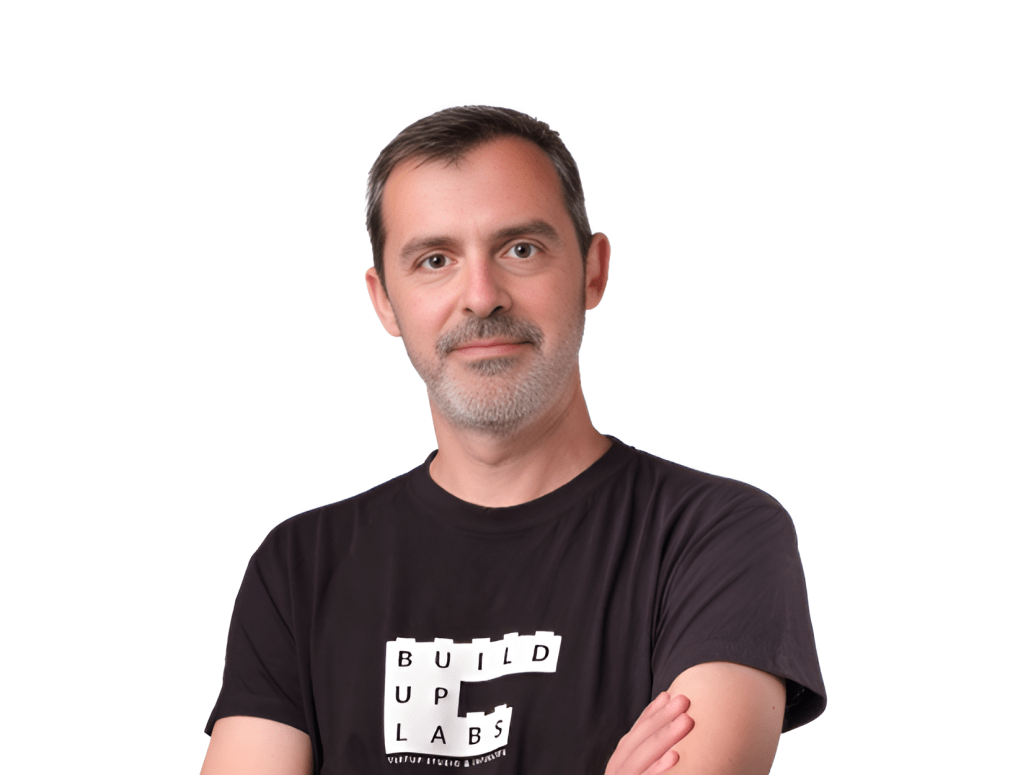
Venture studios could significantly benefit Portugal’s startup ecosystem, especially in academia and corporates, as the model has proven to outperform traditional startup building in success rates, returns, and speed to scale, says Rui Gouveia, CEO of Build Up Labs.
“We truly believe that the studio model could have a very specific impact in two sectors: academia and corporates. For universities, it can provide a path from research to market in a more effective way. For corporates, it enables innovation at startup speed,” Gouveia told Portugal Startup News.
Gouveia has spent years working hands-on in company building through Build Up Labs, a Lisbon-based company that operates as both a venture studio and a startup incubator and has recorded five exits, most recently with the 2023 acquisition of Tap My Back by a Texas-based company.
He is now also contributing his experience at a broader ecosystem level as a founding member and president of STUDIOS.PT, a newly created association working to professionalize Portugal’s venture studio industry.
It aims to make the model a “logical option” for entrepreneurs, corporations, universities, and investors seeking to build innovative businesses in a structured, efficient, and lower-risk way.
The association estimates that only 10-15 venture studios currently operate in Portugal, highlighting how early the model still is nationally and why raising further awareness is one of its priorities.
According to the Venture Studio Forum, a global hub uniting operators, investors, and ecosystem partners across the studio landscape, a venture studio is a company that builds other companies while acting simultaneously as an entrepreneur, investor, and operator, clearly distinct from funds, accelerators, incubators, and other support entities.
The forum points to systematic company creation, hands-on co-building, and strong performance as key reasons behind the model’s global growth.
Industry data supports this. Venture-studio startups show around a 30% higher success rate than traditional startups, with 84% reaching seed stage and 72% reaching Series A, compared with 42% in the traditional model. Average returns also differ sharply, at about 53% internal rate of return (IRR) versus 21.3%.
Gouveia attributes this performance mainly to what he describes as “de-risking through systematic execution,” including shared operational teams and structured validation that reduce early mistakes in hiring, cash-flow management, legal setup, and technology.
He also challenges common misconceptions about the model. “Studios are not just well-funded incubators,” he said, emphasizing that they act as co-founders rather than mere mentors. On equity, he added that while studios typically take larger stakes, “a smaller percentage of a studio-built company is often worth more than 100% of a solo venture.”
In the full interview below, Gouveia discusses how venture studios select and validate ideas, what founders should expect in terms of equity and control, why adoption in Portugal has lagged behind other European ecosystems, how STUDIOS.PT aims to help structure and scale the sector in the coming years, and other related topics.

1- What do you see as the top five competitive advantages of the venture studio model compared to incubators and accelerators?
I don’t see a need for competition, but I do see an opportunity for cooperation. Studios main differentiators are:
- Deep operational involvement: Unlike incubators that provide mentoring or accelerators that focus on growth catalysts, venture studios act as co-founders, providing hands-on building and operating capabilities.
- Comprehensive shared resources: Studios provide services across recruitment, legal, accounting, marketing, and technology, taking this burden from the founding teams.
- Higher capital investment: With typical investments of €50K-€500K compared to €0-€15K (incubators) or €20K-€150K (accelerators), studios provide substantial runway for proper validation and development.
- Systematic company building methodology: Studios apply tested frameworks and accumulated knowledge across multiple ventures, creating a repeatable process that increases success probability rather than relying on individual founder trial-and-error.
- Aligned long-term partnership: With equity stakes of 20-60%, studios are genuinely invested in long-term success, not just providing short-term support or preparing companies for the next funding round.
2- Industry data shows that venture studios achieve around 30% higher success rates and an average internal rate of return (IRR) of 53%, versus 21.3% for traditional startups. What do you see as the main driver of this gap?
The primary driver is de-risking through systematic execution. Think of it like the difference between a solo mountain climber and an expedition with experienced guides, proven routes, and support infrastructure.
Traditional startups fail most often due to preventable mistakes like poor market validation, cash flow mismanagement, wrong hires, legal issues, or lack of technical expertise. Venture studios minimize these failure modes.
The 53% IRR reflects not just higher success rates, but also faster time-to-market and more efficient capital deployment.
3- How is idea selection in a venture studio different from that of traditional startups?
Traditional startup founders typically start with personal passion, observed problems, or perceived market gaps. Selection is individual and often driven by what the founder wants to build.
Venture studios tend to have a more systematic and portfolio-oriented approach:
- Thesis-driven ideation: Studios develop investment theses based on market trends, emerging technologies, and strategic opportunities.
- Rigorous validation frameworks: Ideas undergo structured evaluation against criteria like market opportunity, technical feasibility, and studio capabilities.
- Portfolio construction: Ideas are evaluated for how they complement existing ventures and diversify risk.
Studios must be more strategic because they’re generating multiple opportunities rather than betting everything on one founder’s vision.
4- What are the three most common misconceptions about venture studios?
“Venture studios take too much equity” – While 20-60% seems high compared to accelerators (5-15%), studios provide significantly more value, acting as co-founder, team, and capital source. The founder’s smaller percentage of a studio-built company is often worth more than 100% of a solo venture.
“Studios are just well-funded incubators” – Studios don’t just mentor or provide space, they build companies alongside founders. It’s the difference between getting advice and having experienced co-founders doing the work with you.
“Founders lose control and autonomy” – The partnership is designed to let founders focus their talent and energy on validation and differentiation while the studio handles infrastructure and expertise gaps. But it’s like a co-founder relationship.
5- Venture studios often work with in-house founders but may also partner with external entrepreneurs. Does Build Up Labs do this as well? If so, how does the process work, and do you source founders proactively or accept applications?
Build Up Labs operates across two types of company formation models:
- The founder model, where concepts are generated and validated by our resident team and we bring in leadership to grow at a later stage. This is our always-on mode of operation.
- The co-founder model, where sometimes, we partner with founders that bring idea and domain expertise. These opportunities are identified within our startup incubator where we are supporting dozens of startups at early stages.
Some studios adopt other approaches, like the Late Co-founder model, where studios join existing early stage startups to help with growth stages. And the Re-founder model, where studios acquire existing startups and rebuild them.
6- Generally speaking, what founder profiles best fit the venture studio model, what are the main tradeoffs founders should be aware of, and what do you most want them to understand before participating in this model?
The profile is similar to any other entrepreneur, but some important traits are:
- Domain experts who understand a market deeply but need operational support to build.
- Collaborative mindset is essential and founders must be comfortable with partnership and shared decision-making.
Regarding tradeoffs, the most important thing founders must understand is that this is a partnership model, not a service model. Success requires mutual commitment, transparency, and aligned incentives – as co-founders have.
7- How are decision-making and equity splits typically structured between founders and venture studios? And how does Build Up Labs approach this in practice? Is equity fixed, or does it vary, and what factors usually determine it?
As in any co-founder agreement, it varies a lot. We approach this on a case by case basis depending on the moment a founder joins a project and the future fundraising strategy.
8- Why do you think the venture studio model has been adopted more slowly in Portugal than in the U.S. and some other European countries?
Several factors have contributed.
To start with, venture studios are still less understood in Portugal. One of the missions of STUDIOS.PT is to bring more awareness to it. And without high-profile success stories in Portugal, founders and investors default to familiar models.
Also, we still have few serial entrepreneurs who typically launch studios after successful exits.
9- What impact could venture studios have on Portugal’s startup ecosystem?
We truly believe that the studio model could have a very specific impact in two sectors: academia and corporates. For universities, it can provide a path from research to market in a more effective way. For corporates, it enables innovation at startup speed.
10- In your opinion, which European ecosystems are doing a good job with venture studios, what can Portugal learn from them, and how can the Portuguese startup ecosystem be optimized to support wider adoption of this model?
There’s good examples from different countries and many specific lessons to be taken from each one.
Germany has a growing corporate venture studio adoption.
France has Hexa, which created three unicorns and is my personal favourite studio. Also in France, Bpifrance, similar to Portugal Ventures, is actively investing in venture studios.
Even our spanish neighbours have two great studios, Antai and Nuclio, founded by exited founders that decided that they wanted to keep building startups in parallel and adopted the studio model.
11- What role is STUDIOS.PT playing in professionalizing the venture studio industry, and what goals has the association set for 2026?
Our mission at the association is simple: to make venture studios a logical option for anyone who wants to create innovative businesses – entrepreneurs, corporations, universities, investors, and public institutions.
Our main goals include:
- Support new venture studios – Help new venture studios launch and succeed
- Advocacy and awareness – Explain the model and its impact on innovation
- Attract capital – Bring institutional investors and family offices to this new asset class
- International collaboration – Connect Portuguese studios with a global network
12- If traditional incubators want to add a venture studio layer on top of their current model, what would they need to change first to make it successful?
Having both structures inside Build Up Labs, I can say there’s some big differences between them, and it’s better to have them “side-by-side” rather than as “a layer on top.”
To make this work, three major differences would need to be addressed:
- The mindset shifts from Mentor to Co-founder.
- Incubators usually don’t have operational capabilities (product, engineering, marketing, finance).
- The business model goes from fee to equity.
Because of this, I find it hard to morph one into the other. It’s better to think of synergies between the two.
13- If you could change one thing about the current incubator and accelerator ecosystem in Portugal, what would it be?
I would suggest that incubators and accelerators explore partnership opportunities with existing venture studios. There are clear synergies between them.
14- What will it take to attract institutional investors, funds of funds, and family offices to venture studios as an asset class?
There’s an international effort going on to create an evaluation framework that makes it easier for investors to evaluate the investment opportunities in this new asset class.
Here in Portugal we still need to do the essential work of explaining the model. It will help when we start having some success stories that build momentum for other studios and capture the interest of investors.
Featured image: Rui Gouveia, CEO of Build Up Labs and president of STUDIOS.PT (Photo courtesy: Rui Gouveia/LinkedIn)

 Portugal Startup News
One response to “Venture studios could reshape Portugal’s startup ecosystem, says Build Up Labs CEO ”
[…] See also: Venture studios could reshape Portugal’s startup ecosystem, says Build Up Labs CEO […]