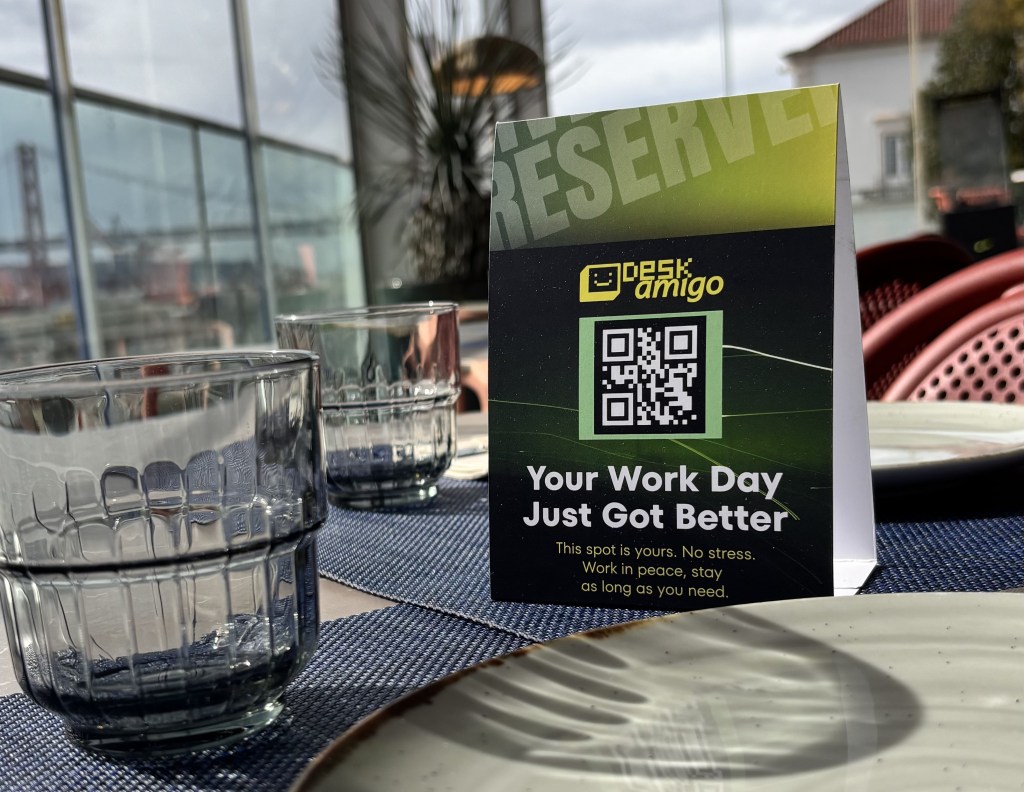
There is always a quiet tension between remote workers at cafés, the venue owners, and other customers. As a remote worker myself, I have felt it for years.
Even when you choose the least crowded place, go during off-peak hours, and keep ordering, it can still be hard to stay focused on your work without worrying that you might be starting to overstay your welcome.
In moments like these, I’ve often wished there were a more dignified way for professionals who, for whatever reason, cannot use coworking spaces and end up working in cafés and similar places – one that is also fair to venue owners.
Now, there is.
DeskAmigo, a marketplace connecting remote workers with underused venue spaces, aims to create a more harmonious arrangement – giving workers a place where they feel respected at an affordable price, while allowing local venue owners to monetize underused tables with full flexibility and pricing control.
The process is straightforward: you choose a location and time, browse nearby venues, and reserve a desk in seconds, with options for hourly bookings or half-day and full-day packages at cafés, restaurants, hotels, bars, coworking spaces, and meeting rooms, among others.
Designed with venues in mind
Sitting with Charles Piers Hector Whitmee, founder and CEO, at Catch Me overlooking the Tagus River – one of the more than 140 venues currently available on the platform – he explains the idea originated from noticing many underused spaces in cafés and hospitality venues, while remote workers were simultaneously looking for places to work.
The challenge, he says, was that the two sides had no simple way to connect. “So we decided to bridge that gap between remote workers and local business owners.”

When I ask why such a seemingly obvious solution had not previously been implemented successfully in Portugal, the birthplace of DeskAmigo, Whitmee points to two factors: timing and perspective.
On timing, he says what once felt like a niche problem has become far more visible as remote work has grown in recent years.
The second factor, he explains, is that the issue had often been approached from the viewpoint of remote workers rather than the businesses hosting them.
DeskAmigo took a different starting point. Before building the platform, the team spoke with around 250 café and restaurant owners across Portugal to understand the problem from their perspective.
“It’s been three years in the making, and we built the product exactly to their desires,” he said, emphasizing that DeskAmigo is designed around venue flexibility.
Spaces can join for free, decide how many tables to offer, set their own prices, and choose exactly when those tables are available.
Onboarding venues and preserving flexibility
Regarding the challenges of onboarding venues, Whitmee said the process has generally been smooth, though it initially required asking hospitality businesses to think about their space differently.
“They didn’t fully appreciate that their space had value,” he said, noting that many cafés and restaurants traditionally see their value primarily in serving food and drink.
The company has focused mainly on smaller independent businesses, which Whitmee described as simpler to work with and the platform’s priority from the start. “We found independent businesses a lot easier than chains,” he noted.
As for potential concerns that the service might disrupt regular customers, he said the platform allows venues to control when and how many tables are available for remote workers.
Many restaurants, for example, offer a handful of tables between lunch and dinner service – such as from 2 p.m. to 6 p.m. – when space might otherwise sit unused. During busier periods, including the summer season, venues can simply remove availability.
Simplicity was also critical to adoption, particularly when working with traditional hospitality businesses. “When you’re doing something completely new, it has to be super simple and intuitive,” Whitmee said.

From cafés to yoga studios
DeskAmigo launched officially in January, following a soft launch in November. Since then, more than 350 users have booked workspaces through the platform.
The marketplace includes a wide range of venues across Portugal, particularly in Lisbon, such as cafés, hotels, coworking spaces, and restaurants.
“We wanted people to go onto the platform and see loads of different types of spaces they could work in,” Whitmee said, adding that the variety allows users to choose between casual and more professional work settings.
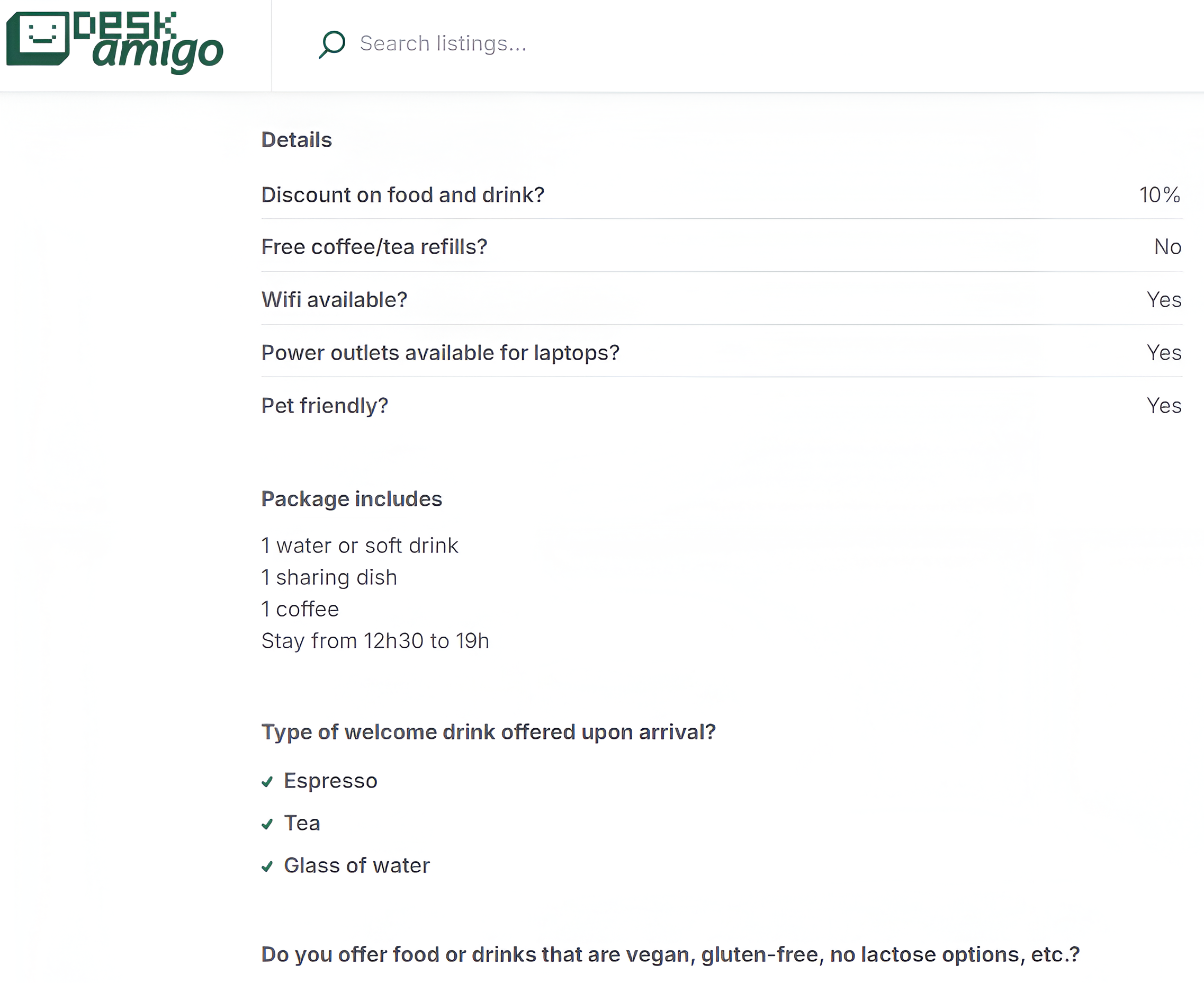
That mix extends beyond traditional workspaces. Gyms, yoga studios, and even surf schools can list suitable areas for remote work. Each listing clearly outlines what the venue offers – from Wi-Fi and power outlets to whether the space is pet-friendly, along with details such as welcome drinks or dietary options.
Listings are reviewed before publication, and in most cases a team member visits the venue within about a week to verify the space and provide DeskAmigo signage and materials.
While the company maintains basic standards – particularly around safety and accurate listing details – Whitmee says the platform is not overly selective about the style or age of venues.
The goal, he explained, is to allow people to work in a variety of places, from traditional local cafés to more modern or unconventional spaces.

Coworking spaces as partners, not competitors
Whitmee said DeskAmigo is designed to complement coworking spaces rather than compete with them. “We don’t want them to see us as competition. We are trying to help them too.”
In some cases, DeskAmigo can act as a funnel for longer-term memberships. “Users can try before they buy,” he noted. “Maybe they might sign up to a monthly package once they’ve actually experienced the space.”
Bookings on DeskAmigo are intentionally short term. “Maximum is just a day,” Whitmee said, emphasizing that the company does not want to compete with platforms that allow people to book for weeks or months.
He added that bringing new visitors into coworking spaces can also make them more vibrant and dynamic, while creating additional networking opportunities.
Pay-as-you-go model and bundled perks
Prices can start as low as €1 per hour in some venues, making it a highly affordable option for quick work sessions. At the same time, many spaces offer half-day or full-day packages that include additional perks.
While hourly bookings are made individually, packages typically allow multiple seats to be reserved together, making them suitable for group bookings. Some packages include lunch, coffee, or tea, while others combine work with activities such as yoga, Pilates, or even surfing.

Whitmee says half-day packages tend to be the most popular. And I understand why. From experience, it removes the pressure to keep ordering something to justify staying longer, which by the end of the day rarely feels like good value for money.
Instead of requiring a minimum spend in cafés – which DeskAmigo’s CEO says often does not work in practice – venues set their own prices for workspaces. DeskAmigo then adds a 7.5% booking fee paid by the user, while venues keep the full price they set.
Whitmee is cautious about subscription models. He believes they can standardize pricing, reduce venues’ control over how they value their space, contribute to subscription fatigue, and exclude users who may not want to commit to another recurring fee.
For now, the company prefers a pay-as-you-go approach, allowing people to try the platform without a long-term commitment and choose whichever location is most convenient for them rather than being tied to a fixed spot.
Revenue impact for venues
When asked what kind of revenue impact venues can expect, Whitmee said it largely depends on how spaces price their offering and how actively they promote the platform to visitors.
“When places price themselves competitively or fairly and they promote the platform, they do really well,” he said.
As an example, he pointed to a hotel that converted an underused lobby into a new source of income through DeskAmigo, generating nearly €2,000 in January alone.
Users and accessibility
The typical user reflects the remote work ecosystem that has grown around Lisbon. “It’s mainly digital nomad types,” Whitmee said.
The average user tends to be millennials and older Gen Zs, many of whom work in tech-related roles. Usage currently skews slightly toward women, at roughly a 70–30 split.
Affordability is central to DeskAmigo’s positioning. “Part of our mission was to make a product that everyone could afford,” he noted, adding that the platform aims to serve both local Portuguese users and international remote workers.
Keeping cities tech-friendly, supporting local businesses
Whitmee acknowledges that the rise of remote work can create tensions in cities that aim to attract global talent.
“There’s a tension between a city’s desire to be a tech hub and the way that local people feel about that,” he said, noting that cafés and restaurants often become the places where that friction is felt most. “One of the battlegrounds for that tension is these third spaces.”
DeskAmigo is intended as a way to ease that pressure by creating a clearer arrangement between remote workers and venue owners while also benefiting the city.
“We are helping to keep the city tech-friendly while also helping local business owners capitalize on this trend,” Whitmee said, adding that the concept has attracted attention from local authorities.
According to him, the idea is not only to serve visiting digital nomads but also to give local residents a nearby place to work for an hour or two when they want a break from working at home.
Working from local venues can also encourage more interaction between international workers and residents. In many cases, he noted, it gives remote workers a chance to engage more with their surroundings and even pick up some Portuguese along the way.
Sustainability through repurposed spaces
Whitmee also frames the platform within a broader sustainability and smart city context. As remote work grows, he argues that cities do not always need to build new workspaces for remote workers.
By turning underused tables in cafés, hotels, and other venues into bookable workspaces, the model makes better use of existing space.
He noted that this approach also allows workers to access nearby spaces rather than traveling across the city, potentially reducing travel and its environmental impact.
Building community around work
Beyond workspace bookings, Whitmee sees community as an important part of the platform’s evolution.
For now, many interactions happen through external platforms such as Meetup, including a community called NewAmigos, where members organize coworking days, social gatherings, and local events.
Over time, the company plans to integrate these features directly into the platform, allowing users to create groups, see who else is working nearby, and organize meetups around shared interests. “We are going to add a layer where you can create your own groups within the app,” Whitmee said.
He believes this human element is becoming increasingly important as work becomes more digital, with many remote workers seeking more authentic, in-person interaction.

Expansion and funding strategy
DeskAmigo already has listings across almost every major urban hub in Portugal. The next step is international expansion, with Spain – particularly Valencia, Barcelona, and Madrid – targeted by the end of 2026.
Whitmee says the company plans to enter new markets with small local teams, typically starting with one transferred team member and a few locally hired salespeople.
The goal is to establish initial partnerships and then allow the marketplace to grow organically, with the platform generally remaining hands-off between the two sides of the marketplace.
The company is currently bootstrapped but plans to reengage with investors it has previously spoken with as it prepares for expansion, while also remaining open to new funding conversations.
Whitmee said the team intentionally waited to pursue funding until the concept had demonstrated traction with both venues and users.
He added that choosing the right investors will be important to preserving the platform’s model, particularly its pay-as-you-go structure.

A broader shift in how people work
Whitmee sees DeskAmigo as part of a wider transformation in how people use workspace. “The trend is really very much towards flexibility,” he said, adding that the shift toward remote and hybrid work has been building for years.
“COVID didn’t fundamentally transform the work landscape. It just accelerated trends that were already existing,” he said.
In his view, changing expectations are also reshaping hiring. “If you are a company and you want talent and you are not willing to negotiate with them about where they work and how they work, but your competitors are, then you’re going to miss out on that talent.”
Whitmee believes flexible workspace access reflects a broader move away from rigid office structures. “Fifteen years ago, it was everyone going into the office nine to five and companies signing ten-year office leases,” he said. “In the future, people are going to want ultimate variety and dynamism.”
Some employers are experimenting with new models. “We are already working with a few companies that let their staff use DeskAmigo as an employee perk,” he noted, noting that some provide workers with a monthly credit to book workspaces.
He also sees an opportunity to modernize the property sector. “Commercial real estate is such an old-fashioned industry,” he said. “It’s so ripe for disruption.”
Whitmee’s view is shaped by more than a decade of experience in emerging markets consulting, focusing on real estate and investment advisory and working with Fortune 500 companies across multiple regions.
For now, however, his priority is simpler: awareness of DeskAmigo. “If we get to the point where pretty much everyone knows what it is, then we’ll reach our KPIs.”
A human view of the future of work
Whitmee also wants to frame the future of work differently from how it is often discussed in the tech world. “We’re trying to redefine that term to make it more about humans,” he said.
For him, that means focusing less on automation and artificial intelligence replacing jobs, and more on how people actually want to work – with flexibility, choice, and spaces that fit into everyday life.
As we talk, a woman working at the desk behind us – laptop open, dog by her side – turns around and apologizes for interrupting. She says she has been overhearing parts of our conversation and decided to look up DeskAmigo.
“I just started following you,” she says, adding that she has been trying to figure out where to work during the day and that the platform sounds like exactly the kind of solution she has been looking for.
For me, that small interaction – a remote worker overhearing the idea and immediately recognizing its usefulness – felt like quiet proof that DeskAmigo is solving a problem many people already experience.
Sometimes validation does not come from metrics or pitch decks. Sometimes it comes from the desk behind you.
Featured image: Courtesy of DeskAmigo



 Portugal Startup News