
By Vitor Soares – Serial entrepreneur and Head of Product & Growth at Tips4y
Five years ago a lean team with a validated idea, a solid – for example – SaaS playbook and decent go-to-market tactics could carve out a market niche. Today, mass-market AI – through large language models – has democratized product creation.
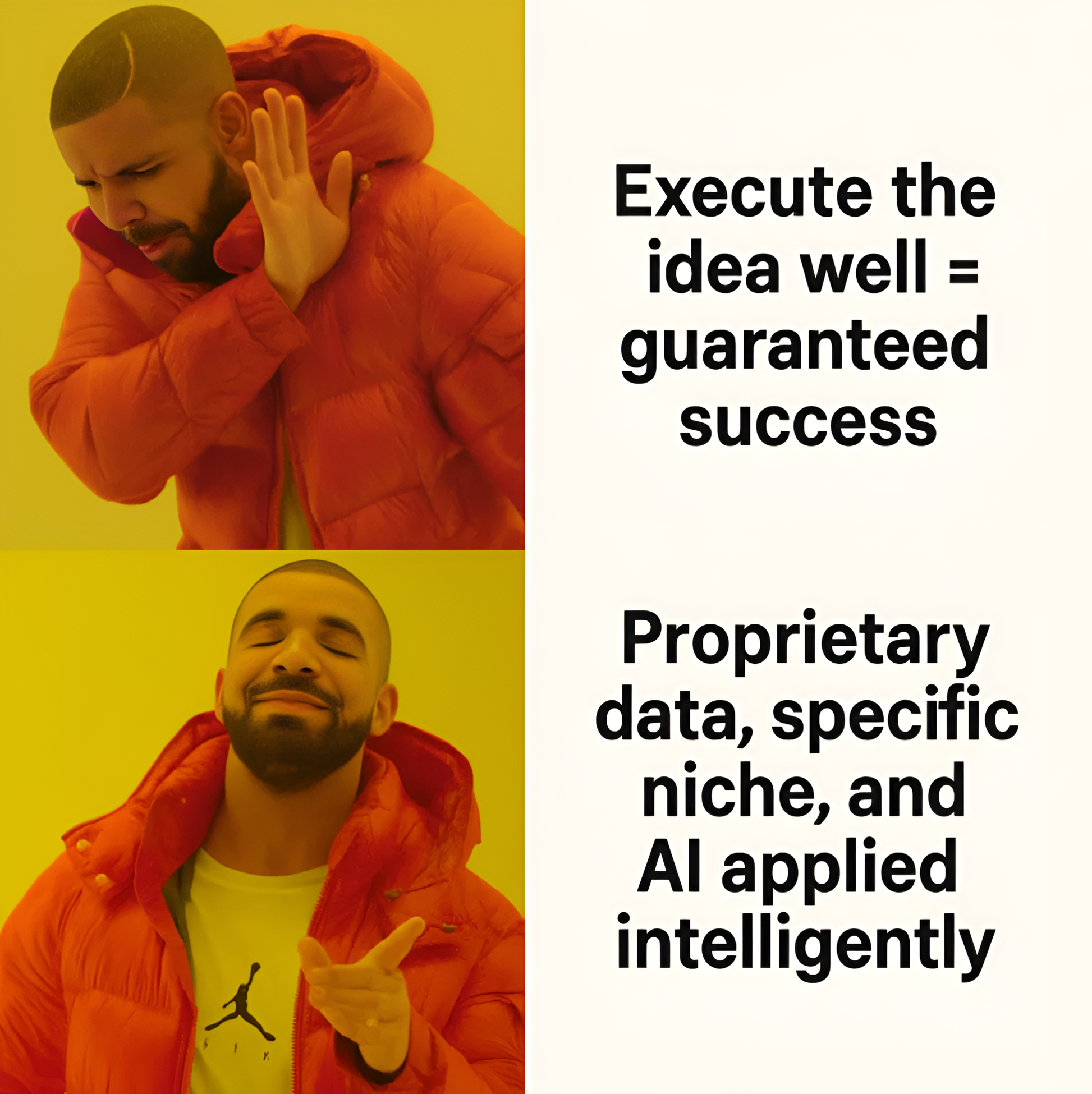
Indie hackers can spin up MVPs in a weekend; incumbents can clone features in a sprint. Barrier to entry has plummeted, while the noise level has exploded. Execution excellence is a basic requirement, not a differentiator.
The odds really are stacked against most ideas, and understanding why is the first step to beating them.
Moats, not minimum viable features
In 2025, the only startup ideas worth building are those anchored by a clear, defensible unfair advantage. In practice that advantage usually comes from one of three sources:
1- Proprietary data
This refers to exclusive, valuable datasets that significantly enhance your product or service, and cannot easily be replicated by competitors.
Consider Tesla’s autonomous driving platform: every Tesla vehicle on the road continuously gathers driving data – covering billions of kilometres and diverse scenarios – that no other automaker has managed to match.
This proprietary dataset is critical for refining Tesla Autopilot algorithms, creating a powerful, self-reinforcing advantage. Each additional kilometre driven further improves their autonomous technology, making Tesla’s lead increasingly difficult for competitors to close.
2- Privileged market access
This can mean unique regulatory relationships, early strategic partnerships, or deep industry expertise that competitors cannot swiftly imitate.
For example, PayPal initially benefited enormously from a privileged relationship as the primary payment option integrated directly within eBay’s marketplace. This exclusive integration allowed PayPal to rapidly gain millions of users at a time when online payment solutions were fragmented, effectively making it the default standard and virtually impossible for later competitors to displace quickly.
3- Overcapitalized superstar teams (Silicon Valley mode)
Raising hundreds of millions to brute-force a market or compete aggressively for top AI talent – like Meta’s recent $100 million offers to poach OpenAI employees (allegedly) – is a valid but extremely resource-intensive strategy. Given the rapidly escalating costs and fierce competition for elite AI specialists, this approach is increasingly out of reach for 99% of founders.
If your concept is not anchored in one of the above, rebuild it until it doesn’t.
AI is the great equaliser… up to a point
Open-source models such as LLaMA or Mistral let a startup fine-tune world-class AI without owning a GPU farm. Automation can cut the human head-count per workflow from 2:1 to 5:1 – or even 10:1 in a few years – putting legacy enterprises under price pressure and opening doors for newcomers.
But pre-trained weights are worthless without exclusive or hard-to-replicate data. Whoever controls the raw signal wins the flywheel; everyone else battles on margins.
Practical playbook for Portugal-based founders
To build a defensible moat around your digital product, your startup should leverage at least one of these approaches:
1- Niche down mercilessly
Typeform dominates marketing teams; Tally grabbed startups and indie makers with minimalist (Notion style), lightning-fast forms. Identify a sub-segment where incumbents over-serve and become indispensable there first.
2- Collect unique data others overlook
Ask: What data can we (legally) gather that our competitors can’t easily access?
Even collecting a relatively small amount of highly specific and clearly categorized data can create a stronger advantage than using enormous but generic datasets. Maybe it can be difficult to start if you don’t have the data, but think of businesses that have it and are doing nothing with it: you can always suggest some sort of partnership.
3- Strike asymmetric partnerships
Distribution deals, industry associations or public-sector pilots can create a gate that latecomers cannot open cheaply.
Despite being a case of bad legal and ethical memory (if you haven’t heard of it, I recommend watching The Dropout), in 2013, Theranos announced a long-term partnership with Walgreens, one of the largest drugstore chains in the US. The goal was to open Theranos “Wellness Centers” inside Walgreens stores across the country, where customers could get quick and affordable blood tests with just a few drops of blood – too bad the product didn’t deliver what it promised.
Each of these paths is viable alone, but startups that manage to combine multiple approaches will significantly increase their chances of creating sustainable competitive advantages.
The upshot
Thanks to AI, building software has never been easier; defending software has never been harder. Portugal’s next generation of breakout companies will not win because they code faster or raise bigger rounds but because they combine:
- Ownership/access to proprietary datasets, that competitors cannot access quickly;
- Privileged market access, for example via partnerships;
- Chosen niche segments that larger competitors underserve and where you are experts.
Ultimately, Portuguese founders who proactively build and deepen these moats from day one will secure a lasting competitive advantage, positioning their startups not just to survive – but thrive – in the hyper-competitive AI era.
About the author:
Vitor Soares currently serves as Head of Product & Growth at Tips4y, a leading IT company that delivers digital solutions to major players in the automotive sector. He has led multiple startups, including Tap My Back, an employee recognition and feedback platform acquired by a Texas-based company in 2023. He specializes in building marketplaces, SaaS products, and AI-driven solutions. Vítor also mentors zero-to-one founders on MentorCruise.
Featured image: Vitor Soares, a serial entrepreneur and Head of Product & Growth at Tips4y (Photo courtesy of Vitor Soares)
Disclaimer: The opinions expressed in contributed opinion pieces are those of the authors and do not necessarily reflect the views of Portugal Startup News.




 Portugal Startup News