Companies spend heavily on training, yet employees still lack enough realistic practice before high-stakes conversations and often forget what they learn.
Lagos-based Replio.eu wants to change that with science-based AI voice training, and is now building a student app on top of the same technology.
Founded by Rasa Sadauskaite and Marcelo Pereira, Replio uses live, open-ended AI voice roleplay to help people practice conversations and workplace knowledge.
Unlike scripted roleplay tools, its personas adapt in real time, while its learning model draws on retrieval practice, spaced repetition, and active recall. The platform supports 58 languages and dialects and combines AI analysis with human judgment.
“The AI persona interrupts you, objects, and changes direction the way a real customer or a real patient does, instead of following a script you can memorize,” Sadauskaite, CEO, told Portugal Startup News. “You can’t fake your way through it, which is exactly why it works.”
Replio is currently running a paid pilot with a global enterprise, with further corporate pilots developing across medicine and fintech.
The company is also building Replio for students, applying the same practice and retention model to education as Europe faces widespread teacher shortages. 40.4% of EU primary and secondary teachers are 50 or older, while Portugal is projected to need 38,779 new teachers by 2034/35.
“We’re not building a training tool. We’re on a mission to prove a new standard of learning,” Sadauskaite said.
Read the full interview below to learn more about Replio’s approach to AI voice training, its early enterprise traction, and its plans to bring the same technology into education.
1- What makes Replio different from similar AI voice training solutions available today, both in terms of product design and learning approach?
Many AI training tools took the old classroom and put it on a screen. Scripted roleplays, a score at the end, and a dashboard for the manager. That model is built on methods designed decades ago, and we’re living in a completely new AI era.
The problem was never access to training. Companies already spend hundreds of billions of dollars on it every year. The problem is that people forget much of what they learn without reinforcement, and many employees struggle to sustain uninterrupted focus for long periods. Replio’s engine is built directly on retention science: retrieval practice, spaced repetition, and active recall.
The first difference is the conversation itself. Replio sessions are live, open-ended voice conversations. The AI persona interrupts you, objects, and changes direction the way a real customer or a real patient does, instead of following a script you can memorize. You can’t fake your way through it, which is exactly why it works.
The second is timing. Most platforms give you feedback after the call is over. Replio coaches you in real time, while you speak, because real-time correction helps reinforce behavior. And the final scores blend AI with human judgment because we believe communication skills should never be graded by an algorithm alone.
The third is that we adapt to how each generation actually learns. A new generation grew up on social media, and fighting that habit is pointless, so we designed around it. Features like swipe-to-learn mimic the feel of a social feed, visual learning formats match shorter attention spans, and sessions take 5 to 15 minutes a day. In this case Replio fits the learner, not the other way around.
The fourth is that we built for enterprise reality. L&D leaders have two chronic problems: proving ROI and scaling rollouts. Every Replio session generates measurable data: scores, skill progression, and ratings a training manager can put in front of a board. Programs are built from the company’s own materials, even a single PDF, and can be automatically translated into any of 58 languages, so a rollout that used to take quarters happens in days.
And it goes far beyond sales, where most competitors stop. With Replio, teams train customer support, HR, healthcare communication, de-escalation, management, or decision-making under pressure. Communication is not a sales skill. It’s a life skill, and nowadays it’s in crisis across every profession.
The fifth is that the same engine solves a problem far bigger than corporate training. Europe faces a growing teacher shortage, with 40.4% of EU primary and secondary teachers already 50 or older. Portugal is an extreme case: 55.6% of teachers are 50 or older, and 78% of public schools began the 2025/26 year with at least one teaching timetable unfilled. By 2034/35, Portugal will need 38,779 new teachers, while only 76,293 of the 121,884 teachers active in 2024/25 are expected to remain.
Replio does not replace a teacher. It gives every student the practice hour a teacher no longer has time to give: speaking a language out loud, defending an argument, an oral exam, or a job interview, with real-time correction and a score the teacher reviews in seconds instead of hours. One teacher can supervise thirty students practicing at the same time.
That is why, on top of our enterprise core, we are building Replio for students. Same engine, same retention science, applied where the gap is widest and where communication is actually formed.
The outcomes follow the science: retrieval practice improves long-term retention compared with repeated studying, while simulation-based learning strengthens complex skills, including communication.
2- What is the biggest misconception companies have about AI voice training, where does that misconception come from, and how are you addressing it?
The biggest misconception is that AI voice training is about the AI, that it is another chatbot, or worse, a way to replace human trainers and human connection.
I understand where the misconception comes from. Everyone has suffered through a robotic customer service line or a scripted e-learning module with a talking avatar. Those first impressions were bad, and they stuck. Add the fear narrative that AI is coming for people’s jobs, and of course L&D leaders are skeptical. They should be.
But here’s the thing nobody stops to notice. Pilots train in simulators before they ever carry passengers. Surgeons rehearse procedures before performing them on patients. Athletes rehearse more than they compete. And yet many people whose entire jobs depend on conversations, salespeople, managers, nurses, support teams, and others, still make their first attempt live.
How do we address the skepticism? We let people try it. The moment someone has a live conversation where the AI persona interrupts them, pushes back, and changes direction, the ‘chatbot’ assumption dies very quickly. Then we show the data: skill progression, scores, measurable growth session after session, the evidence an L&D leader can put in front of a board. And we keep humans in the loop by design: managers review sessions, and final scores blend AI with human judgment.
So we prove to them that the trainer doesn’t disappear on Replio. The trainer finally gets to focus on building superpowers in every one of their trainees. Industries from finance to medicine to manufacturing have rebuilt themselves around new technology: finance went digital, medicine went data-driven, and factories went automated. Learning is still waiting for its new standard. And that’s what we’re building.
3- Where do you believe AI is already better than human trainers, and where do humans remain irreplaceable?
AI is already better at patience combined with something no human can offer: being there whenever the learner is ready. Maybe it’s 6 am and you have the most important negotiation of your career in three hours. Maybe it’s 10 pm and tomorrow’s presentation won’t let you sleep, so you decide to run it one more time.
An AI persona will practice with you in that exact moment, and repeat the same difficult conversation fifty times without ever losing patience. Real preparation doesn’t happen on a training calendar, because the right time to learn is individual, and different for every one of us.
But here’s the deeper reason AI works for practice, and it’s something we don’t like to admit about ourselves. People often don’t fail to learn because they lack information. They fail because they’re afraid to look stupid. Nobody wants to fumble an objection in front of their manager, or role-play a difficult conversation while their colleagues watch. So people avoid practicing the exact skills they need most.
AI can lower the shame barrier. For the first time, there’s a place where you can fail as many times as you need, as fast as you want, failure costs you nothing, and you can build skills through repeated practice before testing them in real life.
But there is a line AI cannot cross: it cannot feel, and it risks nothing when it talks to you. So it can perfect everything measurable: the skill, the technique, and the delivery, but it cannot see the whole person behind the performance, because a strong personality is never just logic and facts. It’s character, emotion, and experience woven into one. Only a human can see that whole, and only a human can shape one.
4- What is the biggest challenge of selling AI transformation to large enterprises today, whether it is technology, trust, budgets, changing human behavior, or something else?
Not budgets. The money is already there. Enterprises already spend huge amounts on training. Not technology. It’s ready, and improving monthly. The real challenges are the two things you can’t really put in a pitch deck: trust and human behavior.
Trust first. Every enterprise leader today is drowning in AI pitches. Everyone suddenly has ‘AI transformation’ on their slide, and some of it is the same old software with a chatbot glued on.
The biggest challenge is human behavior, when an employee decides whether to open the tool or not. You can buy software with a signature. However, you cannot buy or guarantee fifteen minutes of a person’s genuine attention. That has to be earned, every single day, in competition with apps designed to capture attention.
Plus, traditional training can leave people with a real learning hesitation, a reflex that says training means something long, at times boring, and mentally challenging, something you survive rather than skills you gain.
Enterprise training has often been built around the information itself, rather than around how people actually learn. We think that’s precisely what has to change. This is exactly why we designed Replio like a consumer product inside an enterprise structure. Short sessions. Swipe-to-learn that feels like a social feed. Adaptation to each learner’s goals and level.
5- At what stage of development is Replio today, and what has been the most important product milestone so far?
Replio is seven months old. In that time we went from an idea to a live product on the web, available in 58 languages, with public pricing and a free plan anyone can try today.
We’re bootstrapped, and deliberately so. There’s real interest from investors, and we’re grateful for it, but even the most famous investors will tell you quietly that the strongest companies are built under constraint. Bootstrapping keeps us honest. We build what customers actually use, nothing else. We know exactly where Replio is going. So when we raise, it will be on our terms and at the right moment: from strength, to make what’s already working move faster.
The most important milestone? A global enterprise running an active paid pilot on a seven-month-old product built by two people. That’s the moment everything became real. It’s not a demo anymore, not a promise, but a corporation trusting us with their teams’ training.
Alongside it, we’ve contracted a European sales and marketing group as a partner, with more corporate pilots on the way in medicine and fintech, and our first case studies are coming out of these pilots.
And the ecosystem noticed. In seven months we were accepted into the European Innovation Council training program with tremendous support from the Research Council of Lithuania, selected for Google for Startups and Cloudflare for Startups, became members of Unicorn Factory Lisboa, and were recognized by Startup Portugal.
Replio is also now available as an app inside the ChatGPT ecosystem. For a bootstrapped, young company, that recognition tells us we’re building something the market has been waiting for.
6- Which use cases are proving strongest in early traction: sales training, customer support, HR, healthcare communication, or something else?
Three are pulling ahead, and each tells us something about the market.
The strongest is new knowledge acquisition. Every organization produces information employees are supposed to know, like new protocols, product updates, policies, and regulations. In reality, few people have time to read it, let alone remember it.
Replio turns that material into short conversational practice, pulling out the key points employees need to learn. This is our retention engine doing what it was built for, and it’s turning out to be a use case with almost no ceiling.
The second is sales, the natural fast mover for us because of our partner. In this case, the ROI is immediate and visible.
And the third is communication and soft skills, like management and leadership.
7- Which industries are adopting AI training the fastest, and where are you seeing the strongest demand?
At seven months in, I won’t pretend to have the full market map, but the pattern in our pipeline is already very clear, and it’s not the industry itself. It’s the stakes of the conversation.
The fastest movers are industries where a single conversation can cost real money, trust, or compliance: banking and fintech, medicine, and large consumer enterprises. Our pipeline comes exactly from there.
These are also heavily regulated sectors. New regulations, protocols, and policies arrive constantly, teams are often required to know them, and nobody has time to read them. That’s both of our strongest use cases in one place: high-stakes conversations plus a constant stream of mandatory knowledge.
The second pattern is multilingual organizations. A company operating across ten European countries could otherwise need multiple training rollouts. On Replio it’s one. Programs translate automatically into any of 58 languages. For pan-European enterprises, that alone changes the adoption math.
So my answer: the strongest demand isn’t coming from one industry. It’s coming from any organization where conversations are expensive and knowledge changes fast.
8- What metrics do your pilot clients typically use to determine whether AI training is actually delivering ROI?
Every case is individual, so we tell every client to measure Replio against their own numbers. If it’s sales training, compare conversion before and after, or against a team that isn’t training yet. If it’s protocol training, look at completion rate: how many people finished, and how many met the deadline compared to previous months.
Replio provides comparable training data. Sessions and minutes actually spent practicing. Skill scores and progression over time, feedback, coaching notes, and AI analysis blended with human judgment after each session. The trainee’s own reflection after each session. Who’s improving, who needs support. All of it exportable and available through the client’s LMS integrations.
9- Are you prioritizing specific European markets first, or Europe as a whole, and why?
All of Europe. That was our founding intention. When we looked at this market, the first voice-training solutions were built in American English, for the US. So we built Replio multilingual from day one: 58 practice languages and dialects, programs that translate automatically, EU hosting, GDPR-compliant by design. Trials in six European markets in our first year proved the demand for exactly what Replio was built on.
10- How do you adapt the product for different markets with different languages, accents, and communication styles?
We train in 58 languages and dialects, and a program built once translates automatically into any of them. The major languages are covered by the architecture itself. For some European dialects, we worked directly with our trial clients.
Communication style adapts through the AI personas. They can take their character from the client’s uploaded content and the type of persona required for that specific training, or they can be configured manually. For example, the persona’s profile, manner of speaking, cultural specifics, racial identity, gender, behavior, and other characteristics.
11- Why did you choose to build Replio from Lagos, Algarve, rather than a larger European tech hub?
My co-founder is Portuguese and Lagos is home, so it was a natural choice, but it also fits how we think. Lisbon and the other big European tech hubs are the epicenters of the startup ecosystem, and everyone wants to be there, which is exactly why we’re not. When everyone rushes to the same place, it gets crowded and too noisy to stand out. We don’t follow the trend. We look for where the next big opportunity is forming.
And that’s where the Algarve proved us right. It has become a genuinely strong community where organizations and startups help each other instead of competing. In a big hub you get networking. Here you get relationships and the power of a real community that wants you to succeed and helps you out with advice that actually moves you forward.
Algarve Evolution, Algarve Tech Hub Lagos, great mentors we found here in Lagos, business events all around, and even TEDx events in Lagos. And when we need Lisbon, it’s right there. We’re members of Unicorn Factory Lisboa, involved with Startup Portugal, and other activities focused on growing the business.
12- Is there anything that has surprised you about how pilot customers are actually using the product compared to what you initially expected?
Yes, absolutely, and the best surprises became product. Some of what pilot users did with Replio, we simply hadn’t planned for, and part of it has already turned into new features. More of it is shaping the updates we’re building right now, which I can’t reveal yet.
My favorite example came through a European agency hired to deliver a training program in Africa, teaching communication basics. We discovered something so simple it had never crossed our minds: culturally, the conversation openers we take for granted, like saying ‘Hello, how are you today?’ simply weren’t part of how people spoke in that local context.
The product assumed a European conversation. Reality corrected us. From that day, we built full cultural customization of AI personas: their character, manner of speaking, and whole communication style, and it’s now one of Replio’s core features. That trial also changed how I see what we’re building: it showed me how much real impact this technology can have on education, and through it, on people’s lives.
That’s honestly my favorite part of running pilots. You can do all the research in the world, but the moment real teams start using the product daily, they show you things no roadmap predicts. We treat that as the most valuable data we have.
13- What is the biggest product milestone you are targeting next?
The product itself. On top of the enterprise core we’re building the Replio student app, born partly from what pilot users taught us. Europe is facing widespread teacher shortages, and Portugal is one of the clearest examples.
The student app gives students back the practice a teacher no longer has time to give: speaking a language out loud, defending an argument, preparing for an oral exam, with real-time correction and a score the teacher reviews in seconds. Same engine, same retention science, a second market that is publicly funded and structurally desperate.
Because we’re not building a training tool. We’re on a mission to prove a new standard of learning. We’ve used technology to transform nearly every sector, yet education has been left decades behind. We now have everything needed to change that.
14- Is there any other comment you’d like to make?
Only this: we are living through a digital attention and education crisis. Many employees struggle to sustain focus, soft skills are high on leaders’ priority lists, and enterprises pour huge amounts into training that is often forgotten quickly, with limited visibility into ROI and scalability.
Attention, communication, and knowledge are one crisis with three faces. For decades, technology transformed every industry except the way we learn. Now, for the first time, the technology exists to fix it, and that’s exactly what we’re building at Replio. Somebody has to set the new standard. We intend to be the ones.
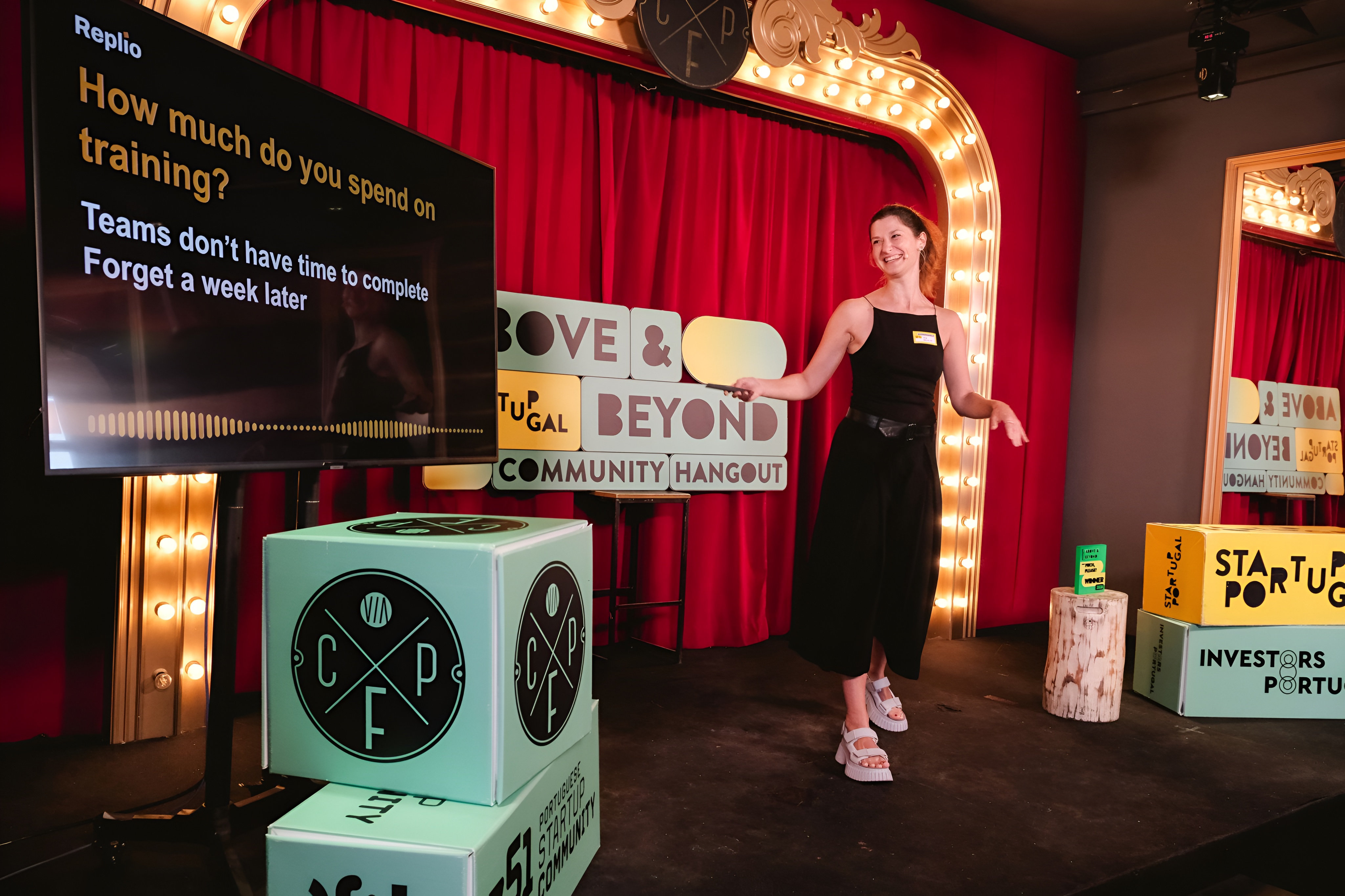
Featured image: Replio co-founder and CEO Rasa Sadauskaite (Photo supplied to Portugal Startup News. Copyright holder unknown.)